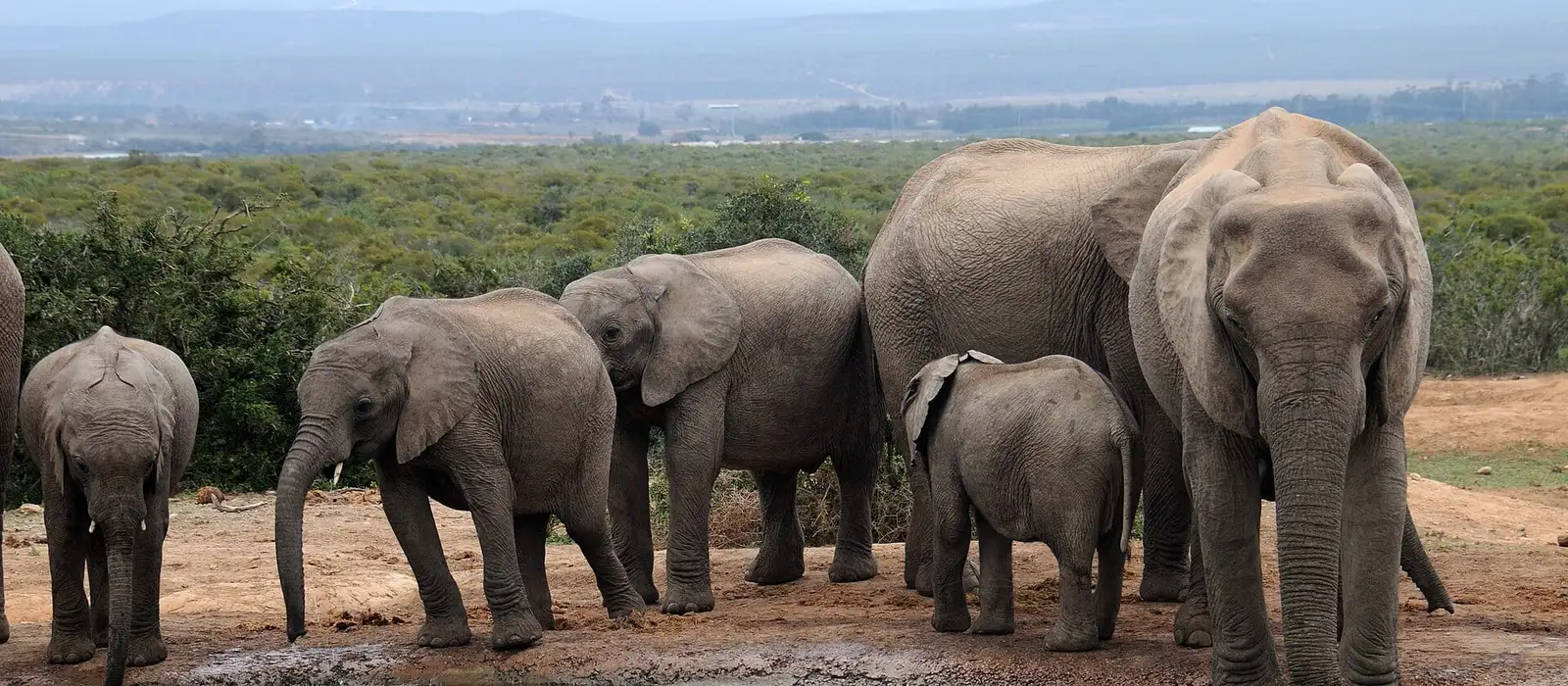
Where Addo is and what its Big Seven means
Addo extends across approximately 180,000 hectares of terrestrial landscapes, around 1,800 km² or 695 square miles. Its wider conservation setting includes mountains, thicket, coast and a marine environment. The main elephant-viewing roads are one part of that larger destination; you will not drive every habitat on a normal day visit.
The Big Seven combines elephant, lion, leopard, buffalo and black rhino with southern right whale and great white shark. The last two are marine animals. This is a description of the park’s conservation diversity, not a claim that a vehicle safari produces seven sightings. Leopard and rhino are also much less straightforward targets than an elephant herd at a waterhole.
Addo works particularly well when you already plan an Eastern Cape or Garden Route journey. It gives you a wildlife stop without requiring the same northward journey as Kruger. The South Africa destination guide helps connect the park to the wider route rather than treating every safari as a separate flight-based holiday.
Getting there from Gqeberha and moving between gates
| Road journey | Approximate distance | Planning time | Useful reason to choose it |
|---|---|---|---|
| Gqeberha to Main Camp via Paterson | 120 km (75 miles) | 1 hour 15 minutes | SANParks game-drive departures and Main Camp facilities |
| Gqeberha to Matyholweni | 45 km (28 miles) | 30 minutes | Southern entrance for a city-based self-drive |
| Main Camp to Matyholweni through the park | 39 km (24 miles) | About 2 hours with viewing | A wildlife outing between the main access areas |
| Main Camp to Matyholweni around the park | 64 km (40 miles) | About 45 minutes | Road transfer rather than game viewing |
| Main Camp to Woody Cape | 105 km (65 miles) | About 1 hour 15 minutes | A separate forest/coastal outing |
The SANParks access directions distinguish the through-park drive from the outside-road transfer. That distinction is essential if you have a booked activity at Main Camp. A southern gate entry does not put you beside the activity reception.
For self-driving, collect your vehicle in Gqeberha and use the entrance that matches the day’s plan. Matyholweni is near Colchester and the N2; for Main Camp, the recommended route continues on the N2/N10 to Paterson and then the R342. As of November 2026, avoid the R335 via Motherwell because of the official approach-road security warning. The quoted journey times start in Gqeberha and do not include rental collection or airport formalities. The car rental guide explains documents and the cost items attached to a rental.
Within the main wildlife area, use the mapped public roads and designated visitor stopping places. Stay in the vehicle around animals. An internal transfer doubles as a game drive only when you allow it the time: a distant booked departure should not be the reason to hurry past elephants on the road.
The quickest outside-road connection between the main access areas is not the wildlife-viewing route. This matters for a split stay or a prebooked drive: use the road transfer when reaching reception is the priority, and give the internal route its own viewing time. Driving less distance inside the park does not automatically mean arriving sooner.
Addo Elephant National Park safari costs
As of November 2026, conservation fees for 1 November 2026–31 October 2027 are as follows. The adult category starts at age 12; the child category is ages 2–11. Proof of nationality or residency determines eligibility.
| Visitor category | Adult per day | Child per day |
|---|---|---|
| South African citizen/resident | R115 | R57 |
| Standard SADC national category | R242 | R121 |
| Standard international category | R565 | R283 |
Daily conservation entry is not an all-inclusive safari program. A self-driver pays conservation entry and supplies the vehicle; a guided activity or overnight reservation adds its own charge. As of November 2026, SANParks also adds a 1% community fund to accommodation and activity reservations, with no published fixed end date.
As of November 2026, displayed accommodation examples start at R537 for a Main Camp tent site and R2,535 for a Matyholweni family cottage. These November 2026 availability-based offers have no stated validity range and are not quotes for every date or party. Occupancy, unit category and additional-person charges can change the invoice.
A hop-on guide for a sedan costs R400 for 2 hours under the rate effective from 1 March 2026, with no published end date. You supply the car and pay conservation fees separately. For a traveler wanting interpretation without an all-day tour package, that is a distinct option from buying a seat on a SANParks vehicle. The budget safari guide shows a worked entry-and-camping subtotal with its exclusions stated.
Self-driving, SANParks game drives and hop-on guiding
Self-driving lets you choose your pace and spend longer at a waterhole. A guided drive adds interpretation and a driver who handles the viewing route. The useful decision is how much of your day you want organized, rather than assuming either format guarantees better animals.
SANParks vehicle drives depart from Addo Main Camp reception and last approximately 2 hours. As of November 2026, the published departure pattern separates summer, 1 October–31 March, from winter, 1 April–30 September.
| Drive | Summer departure | Winter departure |
|---|---|---|
| Sunrise | 05:30 | 06:30 |
| Morning | 09:00 | 09:00 |
| Midday | 12:00 | 12:00 |
| Afternoon | 15:00 | 15:00 |
| Sunset | 17:30 | 17:00 |
| Night | 19:30 | 19:00 |
As of November 2026, children under 6 are not permitted on these vehicle drives, and guests report 30 minutes before departure. Confirm the operational departure with the game-drive office because seasonal changes and daily conditions can alter it. The current payable seat price is supplied through SANParks bookings; the hop-on tariff above is a different service and must not be used as its price.
Spekboom guests cannot treat Main Camp’s sunrise, sunset and night departures as ordinary outings from their tented base. The wildlife-area gates constrain movement outside normal viewing hours. Choose Main Camp when those early or late activities are central to your stay.
What to do beyond a quick elephant photograph
Start with a main wildlife-area circuit, using the mapped waterholes rather than searching only for predators. Hapoor and Domkrag are established names on the visitor map. Allow the journey between Main Camp and the southern section to become the outing; the 39 km route already has a roughly 2-hour viewing baseline before a particularly long stop.
Main Camp’s waterhole lookout and underground hide offer a different perspective without another long drive. Allow a suggested 20–30-minute pause, especially during a midday break; this is an itinerary allowance, not a timed admission. Use them during a break between vehicle outings, particularly when you are staying in the camp. The PPC Discovery Trail adds a short, accessible introduction to the setting. These facilities are better combined with time in the wildlife area than treated as a separate rushed checklist.
For a longer visit, Woody Cape is a separate forest and coastal area. The 7 km (4.3-mile) Dassie Trail belongs there, while the Alexandria hike is a 2-day undertaking. Main Camp to Woody Cape takes around 1 hour 15 minutes by road before the walk begins. Choose that outing for its forest and coast, rather than expecting another concentrated elephant drive.
Whale viewing belongs to a separately arranged licensed marine excursion from Gqeberha. Bird Island is ecologically sensitive and is not offered as an ordinary visitor landing trip. Do not add an ocean excursion to a land itinerary solely to chase the phrase Big Seven; sea conditions and the appropriate wildlife season determine whether it suits your plans.
Where to stay: budget, self-catering and private lodges
Main Camp is the most convenient activity base. Matyholweni suits southern access and a quieter self-catering plan. Nyathi is another accommodation setting, while a private concession lodge combines the stay with its own guided operation. Match the location to the safari format before choosing the room.
Budget bases
- Addo Rest Camp - Main Camp - Budget. Camping and safari-tent categories place you near the main activity departure point and waterhole facilities.
- Spekboom Tented Rest Camp - Main wildlife area - Budget. Furnished tents use communal kitchens and bathrooms beside a fenced hide and waterhole.
Spekboom is about 12 km (7.5 miles) from Main Camp and 27 km (17 miles) from Matyholweni. Overnight guests remain inside its fenced hide area between sunset and sunrise. Its attraction is the setting and night waterhole, not unrestricted after-dark driving.
Mid-range self-catering choices
- Matyholweni Rest Camp - Southern Addo near Colchester - Mid-range. Its cottages are close to the southern entrance and about 3 km (2 miles) off the N2.
- Nyathi Rest Camp - Zuurberg foothills - Mid-range. Its separate setting approximately 12 km (7.5 miles) from Main Camp suits travelers prioritizing a more secluded base.
The relative tier here reflects the accommodation format, not a promise of a fixed nightly rate. A larger family cottage can cost more than a smaller unit in a supposedly higher tier. Narina Bush Camp is temporarily unavailable for bookings and is not included as a place to book.
Luxury private stays
- Gorah Elephant Camp - Private Addo concession - Luxury. Its 11 permanent tented suites provide a lodge-based alternative to public-camp self-driving.
- RiverBend Lodge - Private Addo concession - Luxury. Its guided lodge setting separates the stay from the normal public rest-camp format.
Private lodge packages should be compared for meals, activities and transfers, while public-camp accommodation is normally a more independent purchase. For a different safari region, the Kruger lodge guide shows how the same distinction works in a much larger park.
When to go and practical safety
Addo’s main section receives less than 445 mm of rain annually on average, with rainfall through the year and peaks around February–March and October–November. January averages run from about 15°C to 32°C (59–90°F); July from about 5°C to 18°C (41–64°F). Pack for a cold early outing even when the daytime forecast sounds mild.
This is not a destination with a simple guarantee that a single dry month delivers every sighting. Waterholes matter because the main section’s water supply is largely supported by boreholes, while weather and vegetation change viewing conditions. A visit that leaves time for patient observation is more useful than an overfilled route.
As of November 2026, Addo is a malaria-free Eastern Cape destination. See a travel clinic and confirm guidance for your whole itinerary before departure if other regions are included. Follow wildlife-area restrictions, carry identification for entry and allow time for the return gate; those practical choices matter more than the accommodation tier.
As of November 2026, additional vehicle-disinfection controls apply when leaving designated game-viewing areas following foot-and-mouth disease detected in kudu in October. Tourism remains open under the park’s biosecurity arrangements; follow staff directions at the exit points. Main Camp’s restaurant is also undergoing construction, with a limited Mugg & Bean menu served from the Lapa across the road.
Book the camp first when you want an overnight stay, then choose any timed drive. A self-drive day from Gqeberha can remain flexible, while a sunrise activity requires a compatible overnight base. The strongest Addo plan is the one in which the gate, bed and activity reception all fit the same realistic day.
As of November 2026, the general accommodation arrival time is 14:00, with departure by 10:00; caravan and tent sites have a 12:00 departure time. Spekboom has its own 13:00 arrival and 10:00 departure arrangement. An early park arrival can still be useful for viewing before the room becomes available, but it should not be treated as a guarantee of early access to the unit.
Frequently asked questions
What does an Addo Elephant National Park safari cost?
As of November 2026, standard international conservation entry is R565 per adult and R283 per child aged 2–11, valid 1 November 2026–31 October 2027. Accommodation and guided activities are separate; self-driving adds no separate game-drive ticket.
What is the Addo Elephant National Park program cost?
There is no single program price covering every visitor. Entry, a SANParks guided drive, a hop-on guide and an inclusive operator excursion are different products, so compare the components of the specific day you want.
Can you do an Addo safari from Gqeberha in one day?
Yes. Matyholweni is approximately 45 km and 30 minutes from Gqeberha, while the recommended Paterson approach to Main Camp is about 120 km and one hour 15 minutes. Choose the arrival gate around the driving route and any timed activity.
Can you see the Big Seven on a normal Addo game drive?
No. Elephant, lion, leopard, buffalo and black rhino are the terrestrial five; southern right whale and great white shark belong to the marine environment. Wildlife sightings are never guaranteed, and ocean viewing is a separate excursion.
Is Addo malaria-free?
Addo is in the malaria-free Eastern Cape. If your wider itinerary includes another wildlife region, see a travel clinic and confirm the guidance for that full route before traveling.
Sources
- SANParks - Discover Addo brochure, park extent and malaria-free setting sanparks.org
- SANParks - Addo directions and distances sanparks.org
- SANParks - Daily conservation fees, 2026–27 sanparks.org
- SANParks - Addo game drives and hop-on guide tariff sanparks.org
- SANParks - Addo current accommodation rates and notifications sanparks.org
- SANParks - Addo Main Camp sanparks.org
- SANParks - Matyholweni Rest Camp sanparks.org
- SANParks - Nyathi Rest Camp sanparks.org
- SANParks - Spekboom Tented Rest Camp sanparks.org
- SANParks - Addo accommodation and private lodges sanparks.org
- SANParks - Addo climate sanparks.org
- SANParks - Addo map and activity locations sanparks.org
- SANParks - Addo vital information sanparks.org
- SANParks - General rates and community fund sanparks.org
- Gorah - Tented suites gorah.hunterhotels.com
- SANParks - Addo biosecurity measures and continued tourism, 13 October 2026 sanparks.org