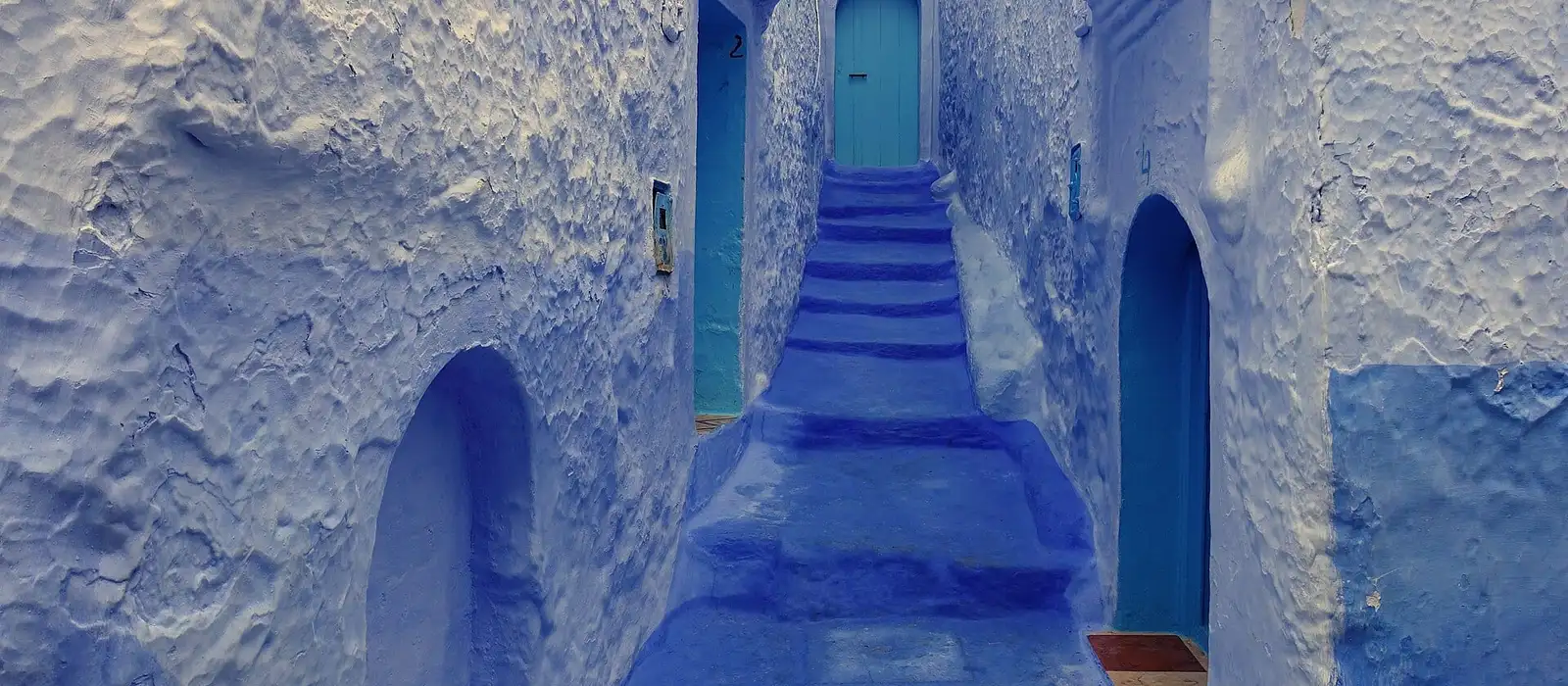
Chefchaouen travel guide to a two-night stay
The old town occupies a steep hillside in the western Rif. Plaza Uta el-Hammam is its central square, with the ocher Kasbah walls and the Great Mosque beside café terraces. Blue lanes spread uphill from the square; the road-accessible newer town lies below. A central room can still involve steps because the medina’s pedestrian routes follow the slope.
Two nights leaves one uninterrupted day between the road journeys. The following sequence is a suggested itinerary, with activity durations used as walking allowances rather than fixed tour lengths.
| Part of stay | Place and activity | Time to allow | Best timing |
|---|---|---|---|
| Arrival afternoon | Plaza Uta el-Hammam and a first medina loop | 1-2 hours | Daylight after the road journey |
| Full-day morning | Kasbah garden, museum and nearby lanes | 2-3 hours together | Before the warmest part of the day |
| Afternoon | Ras El Maa spring and stream | 30-45 minutes at the spring | After lunch or before the viewpoint |
| Late afternoon | Spanish Mosque viewpoint | About 30 minutes uphill from Ras El Maa | Late light, with daylight for the descent |
| Last morning | A short repeat walk in the medina | About an hour | Before the onward road journey |
Getting there from Tangier, Tetouan and Fes
Chefchaouen has no railway station or commercial airport. Tangier Ibn Battouta Airport (TNG) is a useful international gateway; Tetouan Sania Ramel (TTU) and Fes-Saiss (FEZ) are alternatives. The distances below are between cities, so an airport pickup adds the journey out from its terminal. Mountain curves matter more than the apparent straight-line distance.
| Starting city | Road distance to Chefchaouen | Usual drive allowance | Coach option |
|---|---|---|---|
| Tangier | About 112 km / 70 miles | 2-2.5 hours | CTM scheduled coach; intermediate stops make it longer than a direct car |
| Tetouan | About 65 km / 40 miles | 1.5 hours | CTM services on the northern corridor |
| Fes | About 194 km / 121 miles | 3.5-4 hours | CTM journeys commonly take 4.5-5 hours |
The Tangier route is the simplest pairing for a short international break. Tetouan adds an Andalusian-influenced medina; Fes is the better continuation for a deeper imperial-city trip. The CTM coach service connects the town with these gateways. A Fes day trip spends roughly seven to eight hours on the road, which is why sleeping here gives a much fuller visit.
The coach station is below the medina. A local taxi bridges the climb to a vehicle-accessible gate, followed by walking inside. Bab el-Ain is a useful southern approach to the old town, while accommodation around Ras El Maa uses the eastern edge. Cars do not drive through the blue stairways shown in photographs.
Getting around the medina
Walk between Plaza Uta el-Hammam, the Kasbah and Ras El Maa. The spring is on the eastern edge rather than a distant waterfall excursion. Choose a loop that returns to the main square, then add an uphill lane if you want another view. The square’s terraces provide a natural break between the enclosed lanes and the open hillside.
Cobblestones, polished steps and gradients make the route less straightforward for wheelchairs or heavy wheeled luggage. The newer town offers easier vehicle access; traditional medina houses prioritize walking access instead. The distance to a gate and the room’s staircase are separate accessibility issues. Comfortable shoes with grip are useful even if the total walking distance is modest.
The Kasbah, square and blue lanes
The Kasbah of Chefchaouen was built in 1471 as both a defensive stronghold and a ruler’s residence. Its enclosure covers 3,477 square meters and includes an Andalusian garden, old prison spaces and an ethnographic museum. The red earthen walls make an immediate contrast with the medina’s blue and white houses. Give the enclosure roughly an hour within a longer morning walk.
As of November 2026, foreign-adult admission is 80 dirhams, with a 40-dirham category for foreign children aged 7-13. These are monument tickets, separate from guiding. The Great Mosque beside the square is an active place of worship; a medina walk does not imply visitor access to its prayer hall.
From the square, follow the pedestrian lanes toward Bab el-Souk or the Ras El Maa side. The interest is the townscape: stepped passages, courtyard doorways and small craft shops. Morning is useful for a longer walk before warm afternoons. Residential doors remain working entrances, so photographs work best from public lanes without occupying someone’s steps or including people without consent.
Ras El Maa and the Spanish Mosque walk
Ras El Maa, also written Ras El Ma, is the spring and stream at the medina’s eastern edge. It supplied the town with water and remains an easy place to see running water beside the hillside. A half-hour pause here fits between the medina and viewpoint rather than requiring a separate vehicle excursion. The water source and the larger Akchour waterfalls are different places.
The Spanish Mosque, Jamaa Bouzafar, stands on the opposite hill above Ras El Maa. The uphill walk takes about 30 minutes from the spring area; allow about an hour for the return walk, plus time at the viewpoint. It is a stony hillside path rather than a cable-car attraction. Late afternoon gives light across the blue roofs, but descending before darkness is more comfortable on uneven ground.
April-June and September-October offer the most useful walking conditions. After heavy rain, the path can be slippery, so current trail conditions are one detail worth checking locally. A roof terrace offers a view without the full climb. Neither option requires turning the afternoon into a longer mountain trek.
Akchour and the surrounding Rif
Akchour is about 45 minutes away by road and serves as a starting point for walks in the Talassemtane area. Its waterfall route and God’s Bridge, a natural rock arch, are separate walking objectives. Treat either as a dedicated half-day or full-day excursion, with the return road journey added. Trying to combine both with a rushed Kasbah visit cuts the time that makes a two-night town stay worthwhile.
Spring is attractive for greener countryside and flowing streams. Summer walks need an early start because the surrounding mountain setting does not prevent hot exposed afternoons. Winter rain can affect paths and river conditions. Longer routes belong with a local mountain guide and an assessment of the actual trail, rather than being an extension of a casual medina stroll.
Where to stay by area and budget
Inside the medina, the advantage is returning to your room between walks and reaching the square without a car. Around Ras El Maa, you are better placed for the spring and Spanish Mosque path. Hillside properties offer broader views and terraces, with more climbing as the trade-off. The tiers below compare relative style, with no claim of a fixed room price.
Budget
- Dar Antonio - Medina - Budget. The guesthouse offers several room arrangements in a traditional house inside the old town.
- Dar Dalia - Ras El Ma area - Budget. The restored guesthouse stands near the spring and has a panoramic terrace.
Mid-range
- Casa Perleta - Medina - Mid-range. The hotel occupies a house with Andalusian-style architecture.
- Dar Echchaouen - Ras El Ma area - Mid-range. The property has a seasonal outdoor pool and a choice of rooms and suites.
Luxury
- Lina Ryad & Spa - Old medina - Luxury. The property offers junior suites and an indoor pool.
- Dar Jasmine - Hillside above the medina - Luxury. Its rooms and suites look across the blue town toward the surrounding landscape.
Lina Ryad has 17 junior suites, while Dar Jasmine has 17 rooms and suites and opened in 2019. A spa or terrace can be useful during the break between the morning walk and evening viewpoint. Pools and room access are property-specific, so a hillside address matters as much as the room’s decoration. The Morocco cities guide helps place these two nights within a longer route.
When to go: temperatures by season
April-June and September-October are the main walking windows. The following rounded values are typical monthly average daytime highs and nighttime lows for the town, not a mountain forecast. January’s average high is around 13°C (55°F), while July and August reach about 31°C (88°F).
| Season | Representative months | Typical daytime high | Typical nighttime low |
|---|---|---|---|
| Winter | December-February | 13-14°C / 55-57°F | 5-6°C / 41-43°F |
| Spring | March-May | 16-21°C / 61-70°F | 7-11°C / 45-52°F |
| Summer | June-August | 27-31°C / 81-88°F | 15-19°C / 59-66°F |
| Fall | September-November | 16-26°C / 61-79°F | 8-16°C / 46-61°F |
Winter is the period for warmer room layers and wet-weather walking. July and August suit early medina outings and longer midday breaks. September keeps warmer afternoons without the midsummer peak; November is distinctly cooler and wetter. Those differences are large enough to change how much outdoor walking fits into a day.
Costs, safety and entry
The main costs are the room, two road journeys, meals and any guide or countryside outing. The Kasbah is a separately ticketed monument; walking the public lanes is different from purchasing a guided tour. A coach-based stay uses a different transport budget from a private return car. No unsupported daily total or fixed room rate is presented here.
As of November 2026, UK safety guidance highlights theft and bogus guides in tourist areas. Use authorized guides and keep the walk on public routes. British citizens can visit Morocco for tourism without a visa for up to 90 days as of November 2026; other passports have their own eligibility. Confirm current entry requirements before travel. The Africa planning guide covers the wider booking sequence.
Frequently asked questions
What makes Chefchaouen a contender for the finest city in Africa?
Its blue medina, compact historic center and Rif setting make a distinctive walking stay. It ranks third in this site's editorial city selection, behind Cape Town and Marrakech.
How long does it take to reach Chefchaouen from Tangier?
The road distance is about 112 km (70 miles), with around two to two and a half hours in a direct car. Airport pickups and scheduled coaches add time beyond that city-to-city drive.
Can you visit Chefchaouen on a day trip from Fes?
The journey is about 194 km (121 miles) and roughly three and a half to four hours each way by car. Two nights in Chefchaouen gives you a full walking day without repeating that journey on the same date.
How long is the Spanish Mosque walk?
Allow about 30 minutes uphill from Ras El Maa to the viewpoint. The return walk takes roughly an hour in total, with extra time for the view and a descent before dark.
Should you stay inside the medina?
Choose the medina for direct access to the blue lanes and central square. Ras El Maa and hillside properties suit travelers who prioritize terraces and views, with steps as the main trade-off.
Sources
- Visit Morocco – Chefchaouen visitmorocco.com
- CTM – coach booking booking.ctm.ma
- Visit Morocco – climate and seasons visitmorocco.com
- Dar Antonio – owner website darantonio-chefchaouen.com
- Dar Dalia – house and location dardalia-chefchaouen.com
- Casa Perleta – owner website casaperleta.com
- Dar Echchaouen – rooms and seasonal pool darechchaouen.com
- Lina Ryad & Spa – suites and facilities linaryad.com
- Dar Jasmine – rooms and location darjasmine.com
- FCDO – Morocco safety gov.uk
- UK FCDO – Morocco entry requirements gov.uk
- Moroccan Ministry of Culture - Chefchaouen Kasbah history and admission e-services.minculture.gov.ma
- Tonaroz Tours - Chefchaouen elevation, transfers and viewpoint walk tonaroztours.com
- Climate-Data - Chefchaouen monthly high and low averages en.climate-data.org
- Moroccan National Tourist Office - Tetouan and nearby route distances visitmorocco.com