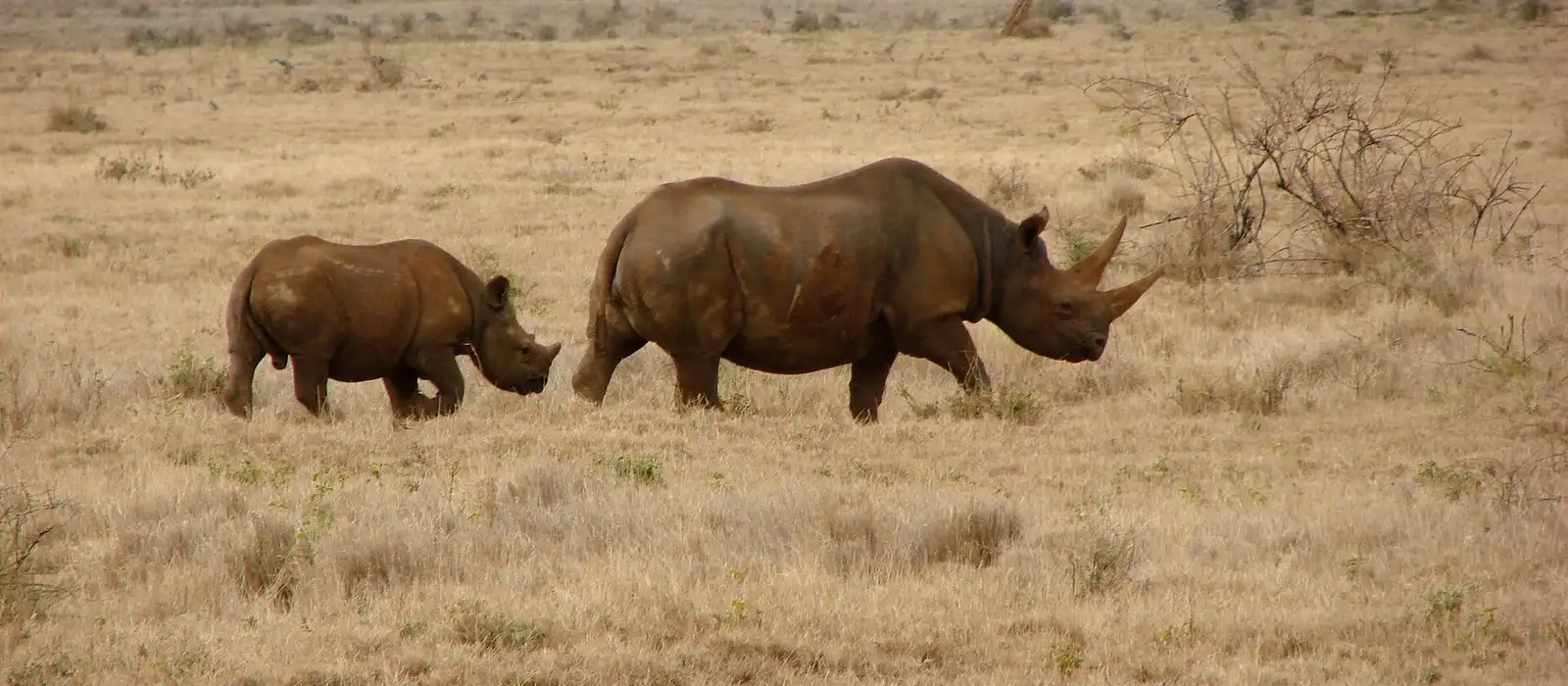
Big Five in Kenya: sizes, access and sighting prospects
The labels below are qualitative planning judgments drawn from species presence, habitat and each park’s conservation focus. “Strong” means a sensible target for that destination; “possible” means present but less dependable; “difficult” means a poor species-specific bet. None is a measured percentage, and even a strong prospect is not a guarantee.
| Park or conservancy | Approximate size | From Nairobi | Lion | Leopard | Elephant | Buffalo | Rhino |
|---|---|---|---|---|---|---|---|
| Maasai Mara | 1,510 km² | About 270 km (168 miles) to example central camps | Strong | Possible | Strong | Strong | Difficult |
| Lake Nakuru | 188 km² | 156 km (97 miles) | Possible | Difficult | Not a normal target | Strong | Strong |
| Ol Pejeta | 90,000 acres, about 364 km² | 220 km (137 miles) | Possible | Difficult | Possible | Strong | Strong |
| Lewa | 62,000 acres, about 251 km² | About 270 km (168 miles) to example lodges | Possible | Difficult | Possible | Possible | Strong |
| Amboseli | 392 km² | 204 km (127 miles) via Iremito Gate | Possible | Difficult | Strong | Possible | Not a normal target |
| Tsavo East | About 13,747 km² | 233 km (145 miles) to Mtito Andei access | Possible | Difficult | Strong | Possible | Very difficult |
| Tsavo West | About 9,065 km² | 240 km (149 miles) to Mtito Andei Gate | Possible | Difficult | Possible | Possible | Sanctuary-focused |
| Nairobi National Park | About 117 km² | About 10 km (6 miles) from the central business district | Possible | Difficult | Absent | Possible | Strong |
Road distances refer to the named entrance or representative lodge approach, not every bed within a park. The Mara and Lewa figures are lodge-route baselines; different endpoints change the journey. A large park also requires additional internal driving after the entrance, so a gate distance should not be mistaken for arrival at the room.
For a broader route, the 13 Kenya destinations guide compares wildlife stops with other parts of the country. Build the safari around habitats and the time between them. Trying to add every row of the table is a poor use of a short holiday.
Maasai Mara: a broad wildlife base with a rhino gap
The Mara’s grasslands, river corridors and resident predators make it a natural base for a varied safari. All five are present, but rhino is the weak link in a simple checklist plan. A leopard can also remain elusive even in a park famous for big cats. Give the landscape time rather than measuring the first drive by how many names you cross off.
The reserve covers 1,510 km², while the Mara Triangle forms its western management sector. Nearby conservancies have their own visitor arrangements and fees. A camp described as a Mara camp is not necessarily inside the national reserve, so the address determines which area your daily drives use.
A representative central-camp road baseline from Nairobi is around 270 km and 6.5 hours; it is not a universal gate time. Flights from Wilson Airport serve individual Mara airstrips, with onward lodge transfers. Suggested allocation: spend several nights in one well-positioned base so you have full viewing days between transfers. July–October is associated with the migration season, but resident wildlife remains the reason a trip can work outside that window.
Lake Nakuru: a compact rhino-focused complement
Lake Nakuru is a practical choice when you want black and white rhino to become a central safari objective. Its 188 km² footprint is much smaller than the Mara or Tsavo, and the route from Nairobi is around 156 km. A representative lodge transfer takes about 2.5–3 hours by road. Use Lanet Gate when it fits the approach rather than adding an unnecessary journey through Nakuru city.
Combine rhino viewing with Baboon Cliff, the lakeshore habitats and Makalia Falls when the route and conditions allow. This gives the day a broader purpose if a particular predator stays out of sight. Elephants are not a normal target here, so Nakuru complements an elephant destination rather than replacing it.
Suggested allocation: allow a full wildlife day, with an overnight if the park lies between other bases. Early and late drives leave time for quieter observation. Its useful role in a Big Five plan is relatively focused: add rhino habitat and lake scenery without expecting the same species mix as the open southern plains.
Ol Pejeta and Lewa: make rhino conservation part of the trip
Ol Pejeta occupies 90,000 acres near Nanyuki and has both black and white rhino alongside the other Big Five species. Nairobi to the conservancy is about 220 km, taking approximately 4–4.5 hours by road. Its conservation experiences are separate from ordinary game viewing; a specialized rhino visit should not be confused with unrestricted access to protected areas.
Lewa’s 62,000 acres offer another rhino-centered safari setting with all five present. The conservancy’s road baseline is around 4 hours to its approach, while individual lodge itineraries can run longer. Flights from Nairobi Wilson to Lewa’s airstrip take around 1 hour; the drive onward to Elewana Lewa Safari Camp is around 40 minutes.
Suggested allocation: use either conservancy as a dedicated base rather than racing through both for duplicate sightings. Lodge-arranged drives are especially relevant at Lewa because vehicle access is controlled. The dry periods of June–October and December–February are useful planning windows, with conditions varying across central Kenya.
Nairobi National Park: rhinos close to the city
Nairobi National Park covers roughly 117 km² and lies about 10 km from the city center. Its wild mammals include rhino, buffalo, lion and leopard, but no elephants. This is the simplest reason it cannot deliver the complete Big Five, regardless of how good a particular morning’s viewing becomes.
Use it for a wildlife day or partial day when your Nairobi schedule allows, with early viewing followed by a sensible return to the city. The main constraint is often your transfer and flight schedule rather than the park’s size. A flight departure should not become a reason to rush or skip the required road-time allowance.
It is especially useful when you want rhinos without inserting a distant reserve into a short itinerary. It remains a real wildlife park, not an animal-viewing garden: animals move and dense cover can conceal them. Give it the same patient approach as any other safari.
Amboseli and Tsavo: choose elephants and landscape deliberately
Amboseli covers 392 km² and is a strong choice for elephants, wetlands and Kilimanjaro scenery. The Iremito approach is 204 km from Nairobi. Lion and buffalo are possible, but rhino is not a normal visitor target and leopard is difficult. The Amboseli hotel guide explains the trade-off between an inside-park base and camps outside the gates.
Tsavo East and West are separate parks. East is associated with extensive dry-country landscapes and elephants; black rhinos exist, but they are not a sensible expectation on an ordinary visitor circuit. West has the Ngulia-linked rhino conservation landscape, together with volcanic scenery and Mzima Springs. Rhino presence within a protected sanctuary does not imply unrestricted viewing across the whole park.
KWS’s expanded Tsavo West rhino sanctuary announcement describes a 3,200 km² conservation area. That is a conservation footprint, not a promise that tourists may drive every part. Suggested allocation: give Tsavo a dedicated stay, especially when combining it with the coast, rather than treating its very large extent as a quick detour for one missing animal.
Entry fees: three different management systems
As of November 2026, KWS publishes the October 2025 tariff with an announced start date of 1 October 2025 and no fixed expiry date. Standard nonresident adult/child rates are US$90/45 for Amboseli and Lake Nakuru, and US$80/40 for Nairobi and each Tsavo park. These are published person-entry planning rates; vehicles, camping and activities add their own fees. Use the KWS tariff card for other residency categories. The rollout was disputed, including a petition recorded in Parliament on 10 March 2026; the figures here are not a guarantee of the payable charge. Confirm the current KWS charge for your visit before payment.
Ol Pejeta’s January–December 2026 tariff is US$110 for a nonresident adult and US$55 for a child aged 3–11. A vehicle with up to 6 seats adds KSh1,000. Its entry is a single entrance for day visitors and a 24-hour entitlement for overnight stays. The Ol Pejeta tariff guide is separate from KWS pricing.
As of November 2026, Narok County’s published Mara schedule charges nonresident adults US$100 in January–June and US$200 in July–December; children aged 9–17 pay US$50. The Mara Triangle uses a 06:00–18:00 day-ticket window, not an automatically rolling 24-hour ticket. The county fee schedule and the sector’s ticket rules must be read together. Lewa packages use their own conservation arrangements and should be priced with the lodge.
Where to base yourself across budgets
Choose the wildlife area first. A cheaper bed outside a gate may add daily driving, while an inclusive lodge can remove separate guiding and vehicle purchases. The tiers below are relative planning categories, not star ratings or a claim that rates remain fixed.
- The Stables at Ol Pejeta - Ol Pejeta - Budget. This conservancy-run option provides a simpler accommodation base within the wildlife destination.
- Makalia Campsite - Lake Nakuru - Budget. Its location at the waterfall area suits equipped campers combining rhino viewing with a park overnight.
- Pelican House - Ol Pejeta - Mid-range. The conservancy’s self-catering house suits travelers organizing their own accommodation and meals.
- Lake Nakuru Lodge - Lake Nakuru - Mid-range. It provides a lodge base inside the park for travelers who do not want to bring camping equipment.
- Elewana Lewa Safari Camp - Lewa - Luxury. Its lodge-arranged safari format pairs with the controlled access of the conservancy.
- Porini Rhino Camp - Ol Pejeta - Luxury. Its tented accommodation provides a guided safari base within the conservancy.
Build a complementary route and travel responsibly
For broad wildlife plus a focused rhino stop, pair the Mara with Nakuru or one of the central conservancies. For elephants and a Nairobi connection, Amboseli plus Nairobi National Park can cover different wildlife strengths. The Kenya versus South Africa comparison helps if you are still choosing the overall safari format.
Leave the final choice with enough viewing time in each base. Moving to another park can diversify the habitat, but it also takes time away from animals already around you. A nearby complementary stop usually adds more value than a distant detour undertaken solely for one missing species.
As of November 2026, official Kenya travel advice identifies regional security and road-travel risks. Confirm the current advisory for your full route before departure and see a travel clinic for health planning. Inside wildlife areas, follow the guide’s directions, respect sanctuary access controls and avoid publishing precise rhino locations.
Pack for cold mornings as well as warm afternoons; the Kenya safari clothing guide develops the seasonal layers and aircraft baggage rules. The best Big Five plan leaves room for animals to behave normally, rather than turning every drive into a race to complete the table.
Frequently asked questions
Where can you see the Big Five in Kenya?
The Maasai Mara, Ol Pejeta and Lewa have all five species. A combination of the Mara and a rhino-focused destination often gives a more balanced plan than expecting every park to deliver all five.
Which Kenya safari is best for seeing rhinos?
Lake Nakuru, Ol Pejeta, Lewa and Nairobi National Park are established rhino destinations. Their visitor arrangements differ, and seeing rhinos in a sanctuary is not the same as unrestricted access to every conservation area.
Does Amboseli have the Big Five?
Amboseli is a strong elephant destination with lion and buffalo, but it is not a normal visitor destination for rhinos. Choose it for its elephants and landscape rather than a complete Big Five checklist.
Can you see the Big Five in Nairobi National Park?
No. The park has lion, leopard, buffalo and rhino, but no wild elephants. Its closeness to the city makes it a useful safari addition rather than a replacement for an elephant destination.
Are Big Five sightings guaranteed on a Kenya safari?
No. Wildlife moves, vegetation changes visibility and the time available matters. The likelihood labels here are qualitative planning judgments, not measured probabilities or promises.
Sources
- UNESCO - Maasai Mara reserve extent and management whc.unesco.org
- Kenya Tourism Board - Maasai Mara wildlife magicalkenya.com
- KWS - Lake Nakuru visitor brochure kws.go.ke
- Sarova - Lake Nakuru road-transfer baseline sarovahotels.com
- KWS - Nairobi National Park kws.go.ke
- KWS - Amboseli National Park kws.go.ke
- Kenya National Bureau of Statistics - Park areas knbs.or.ke
- KWS - Tsavo East National Park kws.go.ke
- KWS - Tsavo West National Park kws.go.ke
- KWS - Tsavo East black rhino monitoring kws.kikosi.co.ke
- KWS - Tsavo West expanded rhino sanctuary announcement kws.go.ke
- Ol Pejeta - Visitor questions and road distance olpejetaconservancy.org
- Ol Pejeta - 2026 tariff guide olpejetaconservancy.org
- Ol Pejeta - Accommodation directory olpejetaconservancy.org
- Lewa - Conservancy extent lewa.org
- Lewa - Getting here lewa.org
- Lewa - Wildlife and habitat, March 2026 lewa.org
- Elewana - Lewa Safari Camp air access elewanacollection.com
- Africa House Safaris - Destination manual, road-route baselines only africahousesafaris.com
- KWS - Published conservation tariff, October 2025 edition kws.go.ke
- Narok County - Finance Act park-fee schedule narok.go.ke
- Mara Conservancy - Conservation fee and ticket arrangements maratriangle.org
- Journey Beyond - Kenya seasons and temperature baselines journeybeyond.travel
- UK Government - Kenya safety guidance gov.uk
- KWS - Announced implementation date, 29 September 2025 kws.go.ke
- Kenya Parliament - 10 March 2026 petition concerning disputed KWS fees parliament.go.ke